Friday, October 01, 2004
A Valediction for Abandonment
If the friends around you change
into canyons, then swell many words
like soaked worms, re-etch re-carve —rejoice
into a deafening hollowness
a dozen reminders of the day, then
softly erase them from the paper.
Regard this ruined thing. Remove all
need from its unfilled whiteness to fill.
What master's stroke, what gossip caught could
wrench this wrong from your ribs?
Turn away from edges with your hands
or eyes loosening their chilly ire.
If the friends around you change
into canyons, then swell many words
like soaked worms, re-etch re-carve —rejoice
into a deafening hollowness
a dozen reminders of the day, then
softly erase them from the paper.
Regard this ruined thing. Remove all
need from its unfilled whiteness to fill.
What master's stroke, what gossip caught could
wrench this wrong from your ribs?
Turn away from edges with your hands
or eyes loosening their chilly ire.
puberty
We are warned,
and yet that draws us
to the house of girls.
We were warned,
and yet that took us
to where we are.
We were blinded
by all of life,
to make our warnings.
We are warned,
and yet that draws us
to the house of girls.
We were warned,
and yet that took us
to where we are.
We were blinded
by all of life,
to make our warnings.
Tuesday, September 28, 2004
Casual shoulders calling
yield! -- an embrace beckoned
across the expanding defense
with a pair of ruddy sticks;
each photo eased away from life
like shaving a sliver of cheese
to share with likewise ruddy tagalongs.
"But come back to the imagination, the erasing--
our erasing of a wicked treasury" says
Blue is to wonder for her;
red was to wander for her warmth,
for her seventeenth chaos.
Beyond legs' rekindled postures.
yield! -- an embrace beckoned
across the expanding defense
with a pair of ruddy sticks;
each photo eased away from life
like shaving a sliver of cheese
to share with likewise ruddy tagalongs.
"But come back to the imagination, the erasing--
our erasing of a wicked treasury" says
Blue is to wonder for her;
red was to wander for her warmth,
for her seventeenth chaos.
Beyond legs' rekindled postures.
Sunday, September 26, 2004
It Rhymes with 'Vogue'
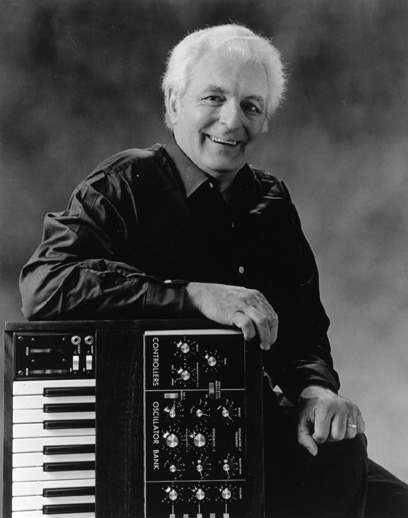
At least three times in the new documentary Moog, Dr. Robert Moog tries to convey
to the camera his belief in the possibility of a connection between man and machine that
is neither tactile nor scientific, but mystical. He is quick to qualify that by 'mystical' he does
not connote 'religious', but rather 'possessing a true power that is yet ungrasped by
science.'
The image of the seventy-year-old engineer, pioneer, musician, and inventor of the analog
instrument known as the Moog staring intently at a circuitry board while trying to explain this
unexplainable phenomenon
is emblematic of the film's approach to its subject: focused less in
technical definitions and textbook diagrams than on the spirit of human ingenuity and
collaboration. Jargon arises here and there, but the basic defintion of what the Moog synthesizer
is is presented by Dr. Moog himself, a simple-spoken and proundly humble man, while standing
around tables piled high with half-finished circuit boards and casing materials. No graphics, no
montages, just a man talking about his invention; rather, he calls it not invention, but discovery.
He allowed himself to be open to the possibilities of electronic music, and one day about a half a
decade ago, he was made to see: discovery.
The risk in such an organic approach to a tech-heavy topic is that it leaves the viewer wondering
if he or she is actually learning anything about the instrument; the genius is that such an
approach matches Moog's carefully articulated belief in the preservation of performance, his
corollary intending the users of his technology not to forget in their rush to make and record
new sounds, that the creation of these sounds should be a public event, in which the creator and
the audience share in the power of the music. Only in such an environment, Moog warns, is a
culture created.
It is exactly this imprecise, quasi-mythological attitude toward music that makes Robert Moog
such a fascinating subject. An engineer, a doctor of science, balanced by a conviction of the
untangible.
Filmmaker Hans Fjellestad follows Dr. Moog as he travels to performances and visits with former
colleagues and musicians who agree that the Moog transformed the face of music: Rick Wakeman,
Keith Emerson, Money Mark.
So what is the Moog synthesizer? In a revealing interview between Moog and DJ Spooky, Moog
reveals the misconception that the term "synthesizer" means that the sounds made by the
machine are "synthetic"; rather, the term was first used because of manifold elements on a
circuitry board being brought together to produce an authentic sound, this "synthesis" ultimately
creating sound. Spooky relates this to his theories of sampling, which is the process of arriving
at a new music through the synthesis of elements from old jazz records, 70s funk records, 90s
pop records, etc.
According to the liner notes from one of my favorite albums ("Moog Indigo", by J.J. Perry, who's
seen in vintage footage in the film), the Moog is "the remarkable instrument or our electronic
age...[that] operates a system of of interconnected oscillators, amplifiers, generators, filters,
mixers and voltage controls which can produce any variation of pitch, wave frequency, overtone
mixture, timbre, dynamics and tone duration." More vintage footage of a Bob Moog in the late
1960s reveals the joy he and his colleagues felt from experimenting with these sounds, never
before heard by human ears.
The film cleverly presents historical context, however, by contrasting popular and critical
opinions of electronic music in its early days with its prevalance in both popular and avant garde
music ever since. Journalists were shocked at the Moog's attack on the purity of "real"
instrumentation. Also questionable were the perversions of the technology for commercial
use. The first to buy Moog synthesizers were advertising executives and producers, hoping to
allure consumers with "space age" sounds and melodies. Never taking definite sides on the
money vs. art issue, Moog is presented as simply a man making the music possible. He was a
businessman as much of an inventor, his allegiance seems more than once to side with more
experimental musicians than commericial ones (although he firmly retains a sense of humility
throughout the film).
At one point, Moog tellingly recalls an early debate over whether a keyboard was necessary. It
would ground the player with a familiar format, but was absolutely unecessary, and in fact
misleading. The theory of the Moog was a machine that processed a single sound through a series
of circuits, changing all of its qualities in infinite combinations. The musician could manipulate
these combinations using any means: levers, knobs, sliders. Keyboards connoted melody, from
which the early inventors were trying desperately to flee. Unavoidable was the seizing of the
instrument for commercial appeal (see Perry and Kingsley, Wendy Carlos).
And, truly, the noise-machine has entered the cultural soundscape: A Clockwork Orange's
soundtrack, Guided By Voices's "Teenage F.B.I.", Sun Ra, t-shirt collections of geeks everywhere,
saturday morning cartoons, everywhere. The reverence for Dr. Moog in the film is overwhelming,
and deserved for such an unassuming but bonafide genius (he built his first therimin before he
was old enough to vote).
The documentary often seems amateurish, or rather, organic and homegrown, but not to a fault.
To explain the mystery of the Moog machine would be to eliminate its dependency on the human
element, the creative element. Moog is correct to assert that the convergence of musician and
machine, of music and audience, is the crucial, and magical, component in electronic music.