Saturday, August 07, 2004
Tool Acquired; A-link Acquired
New permanent links:
The Metacritic - A remarkable round-up of all critical response to new releases. Excellent format.
Red by A.
New permanent links:
The Metacritic - A remarkable round-up of all critical response to new releases. Excellent format.
Red by A.
Friday, August 06, 2004
experiment new poetry new experiment:
(explanation: I'm recording this, a first draft of a poem, on 07 August, before it has been read and edited at will by co-members of a private Wiki collective I have recently joined. I will start posting revisions when things start shifting noticeably.)
(explanation: I'm recording this, a first draft of a poem, on 07 August, before it has been read and edited at will by co-members of a private Wiki collective I have recently joined. I will start posting revisions when things start shifting noticeably.)
if you are reading this, change this title
Rapping of knuckles for us
across the face of a gory sea
becomes
a music. Well, at least the grays in that
cloud
should be enough kinds of imitated
grief.
How will we remember this A) sand,
B) spread of blue blanket, or C) flock of
words?
Oh fucking air, the expensive questions
we don't mind sharing in it this afternoon
while the waves abbraisive as jr. high
school
flatten out their fatty torsoes and heave a slew of
deaths
upon the beach. We arrived at "brooding and
drunk,
I served a life" because it sounded like "rudely
defunct
windsurfing" and we always mis-hear what is
harmless
as something shameful we hide. And then nothing but
laughing
at salt, and at history.
Finally, Some Thoughts On A Current Musical Interest

Althought technically his third album, Devendra Banhart's Rejoicing in the Hands marks the first time 23-year-old vagabond sat down to record music intended for release. The deserved acclaim spurred by his debut, 2002's one-of-a-kind Oh Me, Oh My..., focused on Banhart's authenticity as an artist (the tracks were recorded by Banhart on used, sometimes damaged, equipment -- musical sketchbooks, not rehearsed tracks -- and Young God Records released them nearly unaltered), and given his already impressive body of work, the lable artist is truly applicable: singer, songwriter, poet, drawer, beard-grower. Having come of age Kerouac-style (under Eastern religious guidance, in Venezuela, poor on the streets and friends' couches of San Francisco and NYC), Banhart has been co-opted (by the likes of Time Out) into the budding experimental-folk scene in New York City, but he is a singular figure in the music world. He's the slightly sinister, slightly inviting cousin to McCartney's "Mother Nature's Son."
Rejoicing in the Hands offers only a slightly cleaner sound, despite being recorded in a living room with a few microphones over ten days during which Banhart wrote and played and played almost non-stop; the intricacies of each pluck and strum are more audible than on Oh Me, and the cleaner capture of Banhart's primeval warble detracts only slightly from its power to haunt and tickle. The deluge of songs was diverted into two albums, the first being Rejoicing and the other scheduled for release this fall. Minimal post-production leaves the work to stand for itself, each cut disturbingly different from anything I have ever heard.
I hesitate to try and define what Devendra Banhart sounds like, as any comparison or metaphor is at best an insult. It's like back-country southern ragtime paired with stream-of-consciousness imagery recorded on a phonograph circa 1925 crossed with sitar-influenced beat-folk circa 1971. Sometimes I think he sounds like an eerie photograph from the 19th century midwest. (Or I kinda think he sounds like all of the Squirrel Nut Zippers first three albums boiled into one man and a guitar). But nothing like his "Fall" or the wry, brief "Tit Smoking in the Temple of Artesean Mimicry" has ever been heard.
The guitar is his anchor from which to experiment. He fingers cradle the strings with the kind of total confidence that results from loving craftmanship, and yet he is often seized with spontaneous shrieks and quivers when singing. Any passage on the album is as challenging and enjoyable to wrap your ears around whether he is singing or not: his playing is that good.
Equally amazing is his singular vocal technique, just as scintillating minus any musical accompaniment. (I await his first a capella album). On several tracks -- "Poughkeepsie," "See Saw" -- he manages to repeat a phrase nearly a dozen times with enough of a sutble twist of pronunciation or rhythm each time to deliciously alter the pleasurable effect of hearing it (witness the playful batch of "we're here to get this baby dancin"s).
Banhart is sincere without being sentimental. If Paul Simon can get away with the occasional puddle of picture-album tears ("Homeward Bound" "Kodachrome"), it's because the melody is probably strong enough to convince. There is not one song on Rejoicing in the Hands that is not unsettling, either musically or lyrically. Even the most dew-eyed painting of a friend has an intricate edge that makes you glance over your shoulder. Behind every second of this record, behind any acoustic flourish over which "out spread some sparkling thoughts," the drive seems to be music's gentle possession of Banhart's very breath.
Althought technically his third album, Devendra Banhart's Rejoicing in the Hands marks the first time 23-year-old vagabond sat down to record music intended for release. The deserved acclaim spurred by his debut, 2002's one-of-a-kind Oh Me, Oh My..., focused on Banhart's authenticity as an artist (the tracks were recorded by Banhart on used, sometimes damaged, equipment -- musical sketchbooks, not rehearsed tracks -- and Young God Records released them nearly unaltered), and given his already impressive body of work, the lable artist is truly applicable: singer, songwriter, poet, drawer, beard-grower. Having come of age Kerouac-style (under Eastern religious guidance, in Venezuela, poor on the streets and friends' couches of San Francisco and NYC), Banhart has been co-opted (by the likes of Time Out) into the budding experimental-folk scene in New York City, but he is a singular figure in the music world. He's the slightly sinister, slightly inviting cousin to McCartney's "Mother Nature's Son."
Rejoicing in the Hands offers only a slightly cleaner sound, despite being recorded in a living room with a few microphones over ten days during which Banhart wrote and played and played almost non-stop; the intricacies of each pluck and strum are more audible than on Oh Me, and the cleaner capture of Banhart's primeval warble detracts only slightly from its power to haunt and tickle. The deluge of songs was diverted into two albums, the first being Rejoicing and the other scheduled for release this fall. Minimal post-production leaves the work to stand for itself, each cut disturbingly different from anything I have ever heard.
I hesitate to try and define what Devendra Banhart sounds like, as any comparison or metaphor is at best an insult. It's like back-country southern ragtime paired with stream-of-consciousness imagery recorded on a phonograph circa 1925 crossed with sitar-influenced beat-folk circa 1971. Sometimes I think he sounds like an eerie photograph from the 19th century midwest. (Or I kinda think he sounds like all of the Squirrel Nut Zippers first three albums boiled into one man and a guitar). But nothing like his "Fall" or the wry, brief "Tit Smoking in the Temple of Artesean Mimicry" has ever been heard.
The guitar is his anchor from which to experiment. He fingers cradle the strings with the kind of total confidence that results from loving craftmanship, and yet he is often seized with spontaneous shrieks and quivers when singing. Any passage on the album is as challenging and enjoyable to wrap your ears around whether he is singing or not: his playing is that good.
Equally amazing is his singular vocal technique, just as scintillating minus any musical accompaniment. (I await his first a capella album). On several tracks -- "Poughkeepsie," "See Saw" -- he manages to repeat a phrase nearly a dozen times with enough of a sutble twist of pronunciation or rhythm each time to deliciously alter the pleasurable effect of hearing it (witness the playful batch of "we're here to get this baby dancin"s).
Banhart is sincere without being sentimental. If Paul Simon can get away with the occasional puddle of picture-album tears ("Homeward Bound" "Kodachrome"), it's because the melody is probably strong enough to convince. There is not one song on Rejoicing in the Hands that is not unsettling, either musically or lyrically. Even the most dew-eyed painting of a friend has an intricate edge that makes you glance over your shoulder. Behind every second of this record, behind any acoustic flourish over which "out spread some sparkling thoughts," the drive seems to be music's gentle possession of Banhart's very breath.
Tuesday, August 03, 2004
{New, smaller picture in replacement 06/08/04}
this is the beard/ i'm always growin'/I know they're here/ I see them floating'
her empress beards/ they float so holy/ their beards are here/ they gently hold me
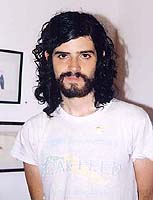
My current fixation is Devendra Banhart, pictured above. For the outrageous bio check out his corner of Young God Records. A review of his latest album (April 2004), Rejoicing in the Hands, is forthcoming. From the site above you can link to a live streaming performance of "A Sight to Behold" on the Jools Holland show.
this is the beard/ i'm always growin'/I know they're here/ I see them floating'
her empress beards/ they float so holy/ their beards are here/ they gently hold me
My current fixation is Devendra Banhart, pictured above. For the outrageous bio check out his corner of Young God Records. A review of his latest album (April 2004), Rejoicing in the Hands, is forthcoming. From the site above you can link to a live streaming performance of "A Sight to Behold" on the Jools Holland show.
